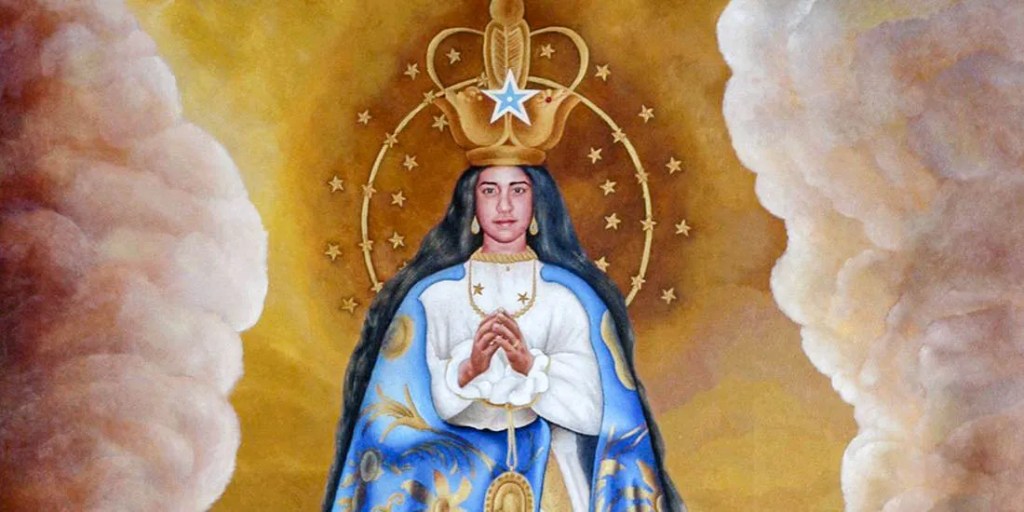
For the 2nd day of our novena, the members of Krishna Keval and Parmar Pavan shared their reflections on Our Lady of Caacupé of Paraguay.
Paraguay is a country located in the centre of South America. The country is land locked as it is surrounded by Brazil, Argentina, and Bolivia. It has a population of around seven million people and the country is 90 % Catholic. It has a democratic government and is blessed with abundant natural resources. It has one of the largest reservoirs of fresh water. Recently Paraguay was voted as having the happiest people in the world. This however was not the condition five hundred years ago. The region at that time was wholly inhabited by the indigenous people of Indians. It was in the early 16th century, some years after Christopher Columbus is supposed to have discovered the Americas, that the French Franciscan missionaries came to Paraguay and set up a mission in the village of Tobati. They preached the Good News and some indigenous tribes like the Guarani tribe accepted and were converted to Christianity. But many other tribes like the Mbayo rejected the message and were strongly opposed to Guarani conversions.
The arrival of Christianity thus brought both hope and conflict. It was in these violent and hostile circumstances that the Apparition of The Blessed Virgin Mary took place. Our Lady often, blesses countries with signs of her presence and closeness, shortly after a nation or a people convert to Christianity, as a way of affirming their faith and introducing them to the power of her intercession. She frequently inspires images that depict her in a manner in keeping with the culture she is visiting. She truly looks like one of their own. This can be seen case of our Lady of Velankanni as well.
It was in the late 16th century that a peasant of the Guarani Indian tribe named Indio Jose had been converted to Christianity by the French Franciscan missionaries, staying in the village of Tobati. Indio Jose was a sculptor and had been chosen by the missionaries to carve an image of the Virgin Mary for the new church that was being made for his tribe. One day he was walking in the forest looking for a large Yerba Mate tree from which he could carve the statue, when warriors of the rival tribe known as the Mbayae nearly discovered him. The Mbayae were violently opposed to the Christian tradition and had declared themselves enemies of all converts. In order to escape his pursuers, Indio Jose fled deeper into the forest and hid within the hollow trunk of an enormous tree. While hiding within the tree, he prayed to the Virgin Mary for protection from the warriors, that they would pass by without seeing him. After finishing his prayer, a pillar of light fell upon him, and Mary appeared to him in a vision.

Indio Jose promised Mother Mary that if she protected him, he would make two sculptures of her from the wood of the tree where he was hiding. Mary accepted this promise and disappeared, leaving Jose alone in the tree and the warriors passing by without seeing him.
True to his word, Indio Jose chopped down the tree and from its wood carved two statues of the Holy Mother, the larger of which he placed within the church at Tobati (where it still resides) and the smaller that he kept for his own devotions.
Some years later in 1603, the nearby Tapaicuá Lake overflowed and flooded the valley of Pirayú, sweeping everything away, including the house of Indio Jose and the statue he kept there. The Franciscan priest, of that time, Luis de Bolaños (1549-1629), accompanied by inhabitants of the region, prayed earnestly for the calming of the waters. Very soon another miracle occurred. The raging waters receded; the statue miraculously appeared floating on the lake. The locals recognized this as a sign of Mary’s presence and began venerating the statue as “Our Lady of Miracles.”
After the statue survived the flood, another carpenter, also named Jose, received permission from the Franciscans to construct a small church in which it would be housed.
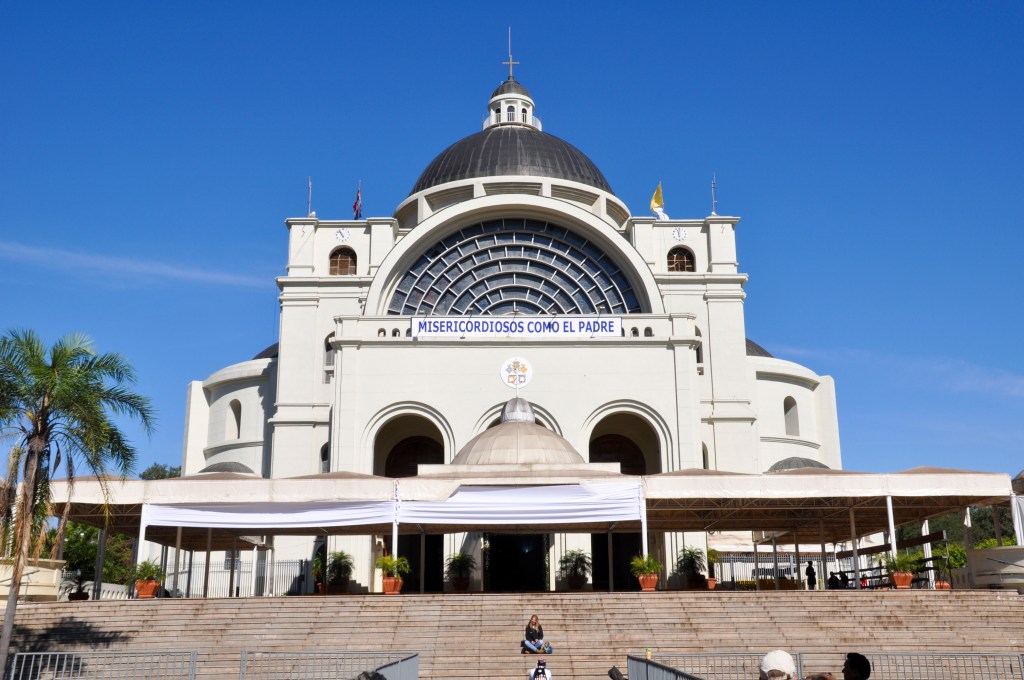
In the centuries that followed, the statue was placed in a succession of at least nine increasingly larger chapels, churches, and basilicas, as devotion to the Blessed Virgin Mary increased and numerous miracles, healings and conversions were being experienced.
Today, Our Lady of Caacupé is a handsome wood carving, approximately 50 centimetres in height, with a delicate oval face and blue eyes. She wears an elegant snow-white tunic and has a sky-blue cloak around her shoulders, both of which are adorned with gold embroidery. Her blond hair falls to her shoulders and her hands are joined in prayer. The statue stands on a sphere that rests upon a large half-moon. Because of her blue cloak, she is also called the ‘Blue Virgin of Paraguay’. This image is one of the best known throughout Paraguay and few homes would be complete without an image or small statue of the Virgin of Caacupé.
In the city of Caacupé, The Virgin of Caacupé is placed behind the high altar of the Cathedral Basilica of ‘Our Lady of the Miracles in Caacupé’, much like our own Our Lady of the Mount, Bandra, and is the most venerated religious symbol in Paraguay. Caacupé is considered the religious centre of Paraguay, the meeting place of the nation and the Church, and the blessed image of Mary has accompanied the formation process of the Paraguayan nationality and the statue of the Virgin has been visited by the devotees since its dedication on 8th December 1765.
December 8th is the Feast of the Immaculate Conception and therefore a date of great importance in many Catholic countries. This day is Paraguay’s most important religious holiday. On the eve of the feast day, an estimated one million pilgrims flood the streets. Entire families arrive with their provisions and spend the night in vigil awaiting the first Mass at daybreak. The cobble-stoned plaza in front of the basilica is large enough to accommodate around 300,000 people and each year it is over filled. During the night, many people sleep on the sidewalks, patches of grass and anywhere else they can find space.
Some of the pilgrims walk the 36 miles from Asunción, the capital of Paraguay, others take buses which run around the clock in a constant stream, some take the bus part way and then walk several hours, others take bicycles, still others walk the last ten miles on their knees, and some even walk the last 20 miles carrying heavy crosses. This is an amazing demonstration of their faith!
The cathedral which now holds the Virgin is relatively modern, a large bright airy building mainly painted in white, and which focuses the eyes of anyone entering towards the Virgin. The cathedral itself was dedicated in May 1988 by Pope John Paul II and then also visited by Pope Francis in July 2015.
On the 8th of December the crowds are so great that with there being far too many people to safely enter the cathedral for mass, open-air masses are held in front of the cathedral so that all who wish to can participate. These masses are also broadcast live on national television.
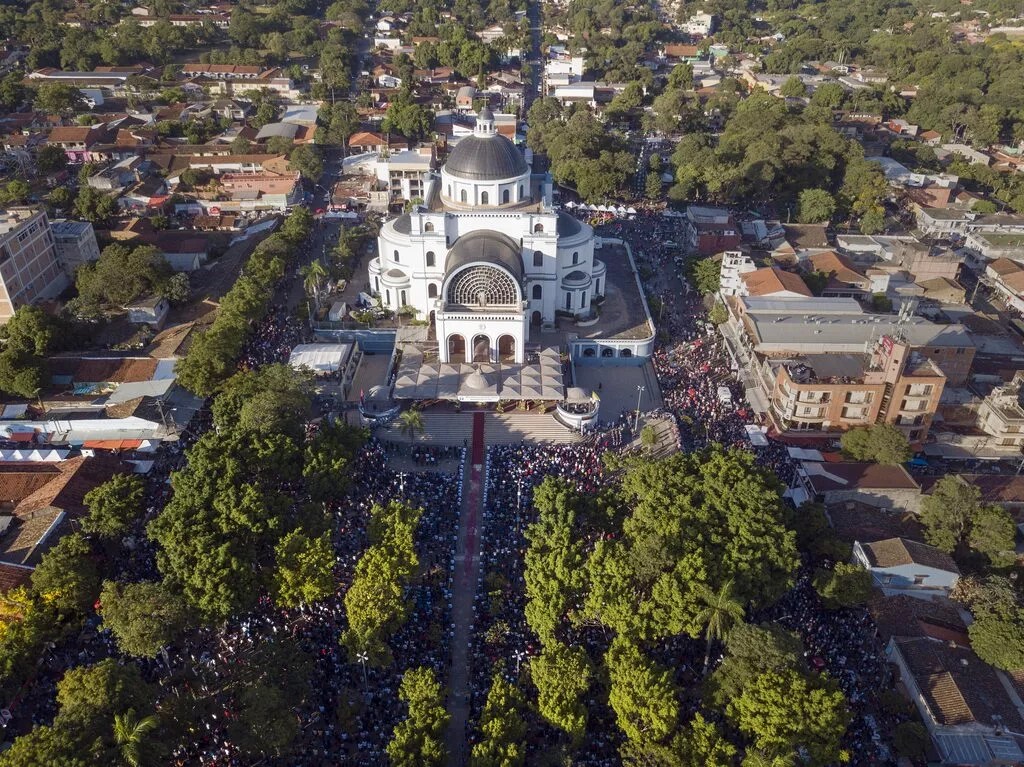
This most important pilgrimage site in the small town of Caacupé, speaks volumes about the devotion of the people of Paraguay to our Mother Mary. Paraguay is a predominantly Catholic state and its reverence to the catholic faith stamps itself strongly to Mother Mary. Paraguay is blessed with abundant natural resources the quality of life is superior to many other countries and the country is by and large peaceful. In many ways this reflects the blessings of Mother Mary upon the country and its people as reflected in Psalm 144 verses 12 to 15
12 Then our sons in their youth
will be like well-nurtured plants,
and our daughters will be like pillars
carved to adorn a palace.
13 Our barns will be filled
with every kind of provision.
Our sheep will increase by thousands,
by tens of thousands in our fields;
14 our oxen will draw heavy loads.
There will be no breaching of walls,
no going into captivity,
no cry of distress in our streets.
15 Blessed is the people of whom this is true;
blessed is the people whose God is the Lord.
 Our Lady of Lourdes
Leave a comment